
In industrial equipment, sealing is rarely as simple as placing a gasket between two metal surfaces. Many machines operate under conditions where components move, doors open and close repeatedly, and tolerances are not perfectly uniform. In such environments, traditional seals sometimes struggle to maintain consistent contact.
This is where inflatable seals become extremely useful.
Unlike conventional sealing components that rely on permanent compression, inflatable rubber seals expand only when pressure is applied. When inflated, the seal presses firmly against a mating surface and creates a reliable barrier. Once the pressure is released, the seal returns to its original shape.
Because of this ability to inflate and deflate, inflatable seals are widely used in equipment that requires controlled sealing without excessive mechanical stress. Industries such as pharmaceutical manufacturing, food processing, aerospace testing, and industrial automation rely on these seals to maintain airtight containment and consistent performance.
This guide explains the fundamentals of inflatable seals—from how they operate and the materials used in their construction to the types available and the industries where they are commonly applied.
What Are Inflatable Seals?
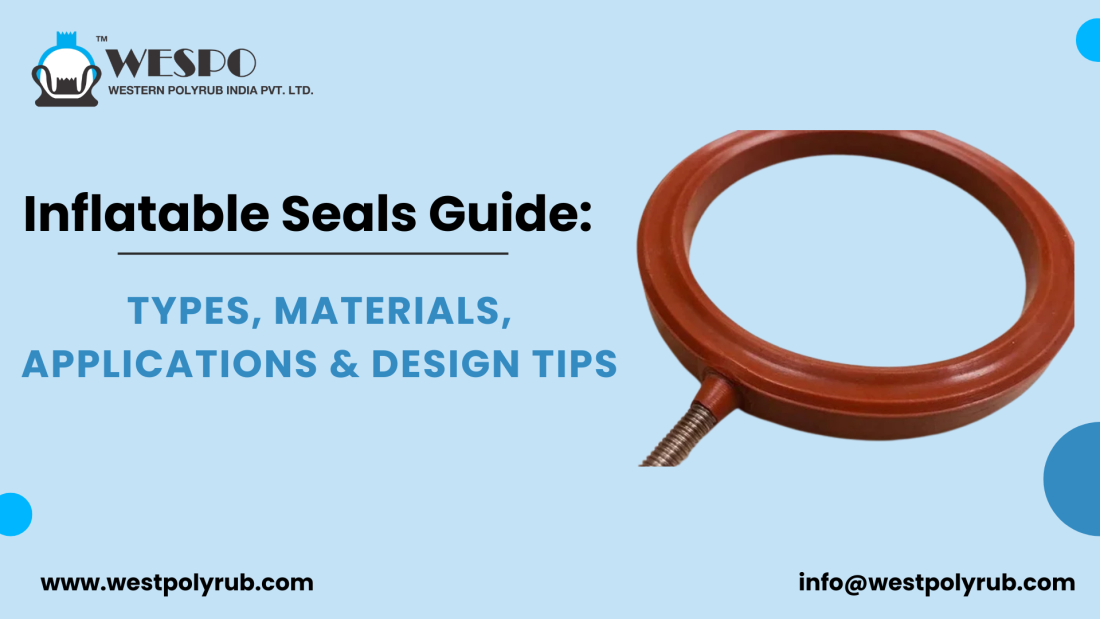
An inflatable seal is a flexible elastomer profile designed with a hollow internal cavity. When air or another fluid is introduced into this cavity, the seal expands outward and presses against a surface to create a sealing barrier.
Unlike traditional gaskets, which remain permanently compressed between two surfaces, inflatable seals remain relaxed until pressure is applied. When the system requires sealing, the internal chamber is pressurized and the seal expands to fill the gap between components.
This ability to adapt to uneven surfaces or larger tolerances makes inflatable seals particularly valuable in applications where precise sealing must be achieved even when surfaces are not perfectly aligned.
Typical characteristics of inflatable seals include:
-
Flexible rubber construction
-
An internal cavity designed for inflation
-
The ability to compensate for uneven gaps
-
Uniform pressure distribution when inflated
-
Reliable operation across repeated cycles
Because they activate only when needed, inflatable seals often experience less continuous stress compared with permanently compressed sealing elements.
How Inflatable Seals Work
Although inflatable seals are used in advanced industrial systems, the basic operating principle is quite straightforward.
The seal is installed in a groove or channel that surrounds the area requiring sealing. When the equipment is inactive or the chamber door is open, the seal remains deflated and does not interfere with mechanical movement.
When the system is ready to operate, compressed air or fluid is introduced through an inlet valve connected to the seal.
As pressure builds inside the hollow chamber, the seal expands outward. This expansion pushes the outer surface of the seal against the mating structure, creating a tight barrier that prevents leakage or contamination.
A typical operating cycle works as follows:
-
The inflatable seal sits inside its groove in a relaxed, uninflated state.
-
The door or chamber closes.
-
Air pressure is introduced through an inlet port.
-
The seal expands outward and fills the sealing gap.
-
Once the cycle is complete, pressure is released and the seal returns to its original shape.
This inflate-and-release mechanism allows inflatable seals to function effectively in systems that require frequent opening and closing.
Types of Inflatable Seals
Inflatable seals are available in several configurations depending on the design of the equipment and the sealing requirements.
Inflatable Door Seals
These seals are commonly used in equipment where airtight door closure is essential. Examples include sterilizers, environmental chambers, and industrial ovens. Once the door closes, the seal inflates and forms a barrier that prevents air leakage.
Clamp-Mounted Inflatable Seals
Clamp-mounted seals are designed for applications where modifying the equipment structure is not practical. They can be installed externally using mechanical clamps, allowing easier integration with existing machinery.
Molded Inflatable Seals
Some applications involve complex shapes or corners that standard extruded profiles cannot accommodate. In such cases, molded inflatable seals are manufactured specifically to match the geometry of the equipment.
Extruded Inflatable Seals
Extruded seals are commonly used for long sealing surfaces in industrial enclosures or containment systems. These seals can be produced in various lengths and profiles to suit different installations.
In many specialized applications, manufacturers develop custom inflatable rubber seals designed to match the exact dimensions and operating conditions of the equipment.
Materials Used in Inflatable Seals
The material used in an inflatable seal has a significant impact on its durability and performance. Different elastomers offer varying resistance to heat, chemicals, and mechanical stress.
Silicone
Silicone rubber is widely used because it maintains flexibility across a broad temperature range and offers excellent resistance to heat. It is commonly used in pharmaceutical and food processing environments.
EPDM
EPDM rubber performs well in applications exposed to water, steam, and outdoor conditions. It also offers good resistance to weathering and ozone.
Viton
Viton, also known as FKM, is selected for applications involving high temperatures, oils, or aggressive chemicals.
Nitrile
Nitrile rubber provides strong resistance to petroleum-based fluids and is often used in industrial machinery.
Selecting the correct elastomer ensures the seal remains reliable under the specific environmental conditions of the application.
Industrial Applications of Inflatable Seals
The adaptability of inflatable seals makes them suitable for a wide range of industrial uses.
Pharmaceutical Manufacturing
In pharmaceutical production environments, maintaining sterile conditions is essential. Inflatable seals are used in isolators and containment systems to prevent contamination.
Food Processing Equipment
Food processing equipment often requires hygienic sealing between chambers and processing zones. Inflatable seals made from food-grade materials help maintain sanitary conditions.
Aerospace Testing
Environmental chambers used in aerospace testing rely on inflatable seals to maintain controlled pressure and temperature conditions.
Industrial Automation
Automated manufacturing systems frequently use inflatable seals in enclosures designed to control airflow or protect sensitive components from dust.
Advantages Over Traditional Seals
Inflatable seals provide several benefits when compared with conventional sealing solutions.
One key advantage is their ability to compensate for irregular gaps. Because the seal expands when pressurized, it can adapt to variations that would cause leakage with rigid gaskets.
Another benefit is adjustable sealing pressure. Engineers can control inflation pressure to achieve the desired level of contact without overstressing the material.
Inflatable seals also experience less continuous compression, which can help reduce long-term wear.
These characteristics make inflatable seals especially valuable in systems where reliable sealing must be achieved under changing mechanical conditions.
How to Select the Right Inflatable Seal
Selecting the correct inflatable seal involves evaluating several technical factors.
Engineers typically consider:
-
The operating temperature range
-
Exposure to chemicals or cleaning agents
-
Required inflation pressure
-
Groove design and dimensions
-
Expected number of operating cycles
In many cases, a standard seal profile may work. However, complex equipment may require custom designs tailored to the system.
Working with an experienced inflatable seal manufacturer can help ensure that the seal design matches the specific requirements of the application.
Common Causes of Inflatable Seal Failure
Even well-designed seals can fail if operating conditions exceed their limits.
Over-inflation is one of the most common causes. Applying pressure beyond recommended levels can stretch the elastomer and weaken the seal.
Material incompatibility can also lead to degradation if the elastomer is exposed to chemicals it cannot withstand.
Improper groove design may prevent the seal from expanding correctly, reducing sealing performance.
Routine inspection and proper system design can significantly reduce these risks.
Design Considerations for Inflatable Seals
When designing systems that incorporate inflatable seals, several parameters must be carefully evaluated.
Important design considerations include:
-
Seal cross-section geometry
-
Groove depth and width
-
Allowable inflation pressure
-
Compatibility between seal material and operating environment
-
Mechanical movement within the system
When these factors are balanced correctly, inflatable seals can provide reliable sealing performance for long operating periods.
Frequently Asked Questions
Use this checklist:
-
Steam or autoclaving → Silicone tubing
-
Continuous flexing or vibration → Santoprene tubing
-
Oil or fuel exposure → Santoprene tubing
-
Medical or food compliance → Silicone tubing
-
Cost-sensitive industrial systems → Santoprene tubing
It’s not about which material is “better.”
It’s about which one fails last in your environment.
Frequently Asked Questions
What are inflatable seals used for?
Inflatable seals are commonly used in sterilizers, containment systems, environmental chambers, and industrial ovens where airtight sealing is required.
How do inflatable rubber seals work?
They expand when air or fluid pressure is introduced into the internal cavity, pressing the seal against a mating surface to create a sealing barrier.
What materials are used in inflatable gaskets?
Common materials include silicone, EPDM, Viton, and nitrile rubber.
Which industries use inflatable seals?
Industries such as pharmaceuticals, food processing, aerospace, and industrial manufacturing use inflatable seals for controlled sealing environments.
Can inflatable seals be custom manufactured?
Yes. Many manufacturers design custom inflatable seals tailored to the dimensions and operating conditions of specific equipment.
Conclusion
Inflatable seals provide a practical solution for applications where traditional gaskets may not deliver consistent performance.
By expanding only when pressure is applied, these seals can accommodate uneven gaps, repeated opening cycles, and demanding industrial environments.
Understanding how inflatable seals work, the materials used in their construction, and the factors involved in selecting the correct design allows engineers to choose a sealing solution that performs reliably over time.
For specialized equipment, partnering with an experienced inflatable seal manufacturer can help ensure the final design meets both performance requirements and long-term durability expectations.


Add a Comment