
Cleanrooms don’t fail loudly—they fail quietly.
A slight pressure drop. A barely noticeable leak. A door that “looks” sealed but isn’t. And suddenly, your environment is no longer controlled.
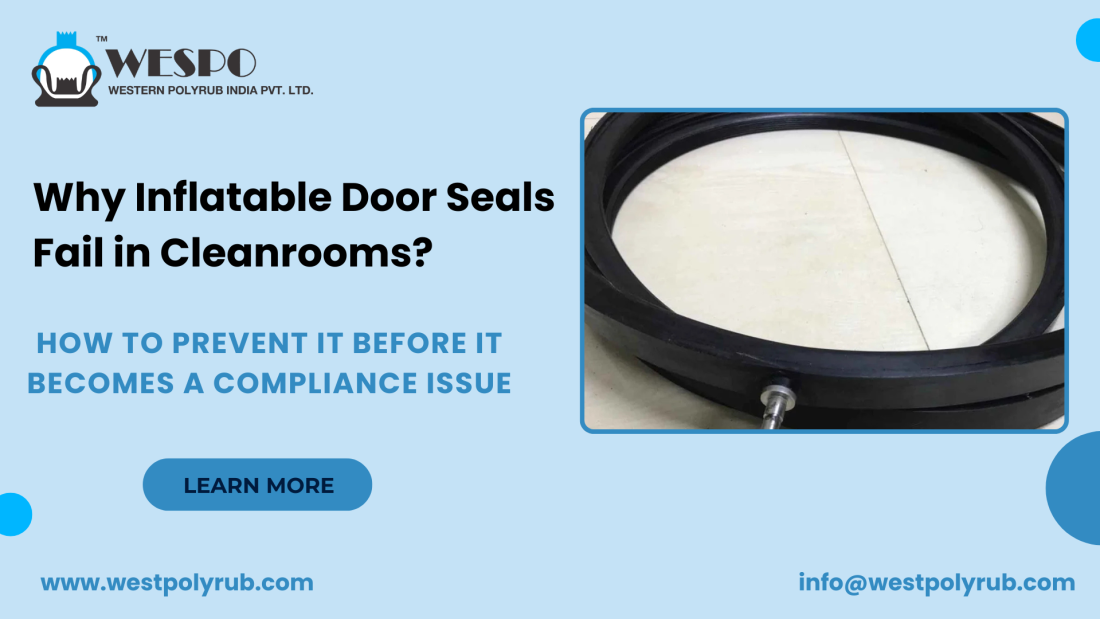
That’s exactly why systems rely on an inflatable door seal instead of a standard gasket. It doesn’t just sit there—it expands, adapts, and creates a tight seal when air pressure is applied.
On paper, it’s a solid solution. In reality, many teams still struggle with recurring failures of the inflatable gasket.
Here’s the uncomfortable truth:
Most of these failures are predictable. And more importantly, preventable.
How an Inflatable Door Seal Actually Works
An inflatable gasket is designed as a hollow rubber profile installed along a door frame. Once the door is shut, compressed air is introduced into the seal.
As the pressure builds, the seal expands outward. This expansion fills any gaps—large or microscopic—between the door and the frame.
Once deflated, it retracts, avoiding constant friction and allowing smooth door movement.
That’s why inflatable door seals are widely used in:
- Cleanroom door systems
- Pharmaceutical isolators
- Autoclave doors
- Airtight chambers
They’re built for environments where zero leakage isn’t optional—it’s expected.
Related Topic : Inflatable Seals Guide: Types, Materials, Applications & Design Tips
The Real Reasons Inflatable Door Seals Fail
Let’s break this down properly. Not theory—real-world failure patterns.
- Overpressure: The Most Common Mistake
This is where most systems go wrong.
An inflatable door seal is engineered for a specific pressure range. Push beyond that—even slightly—and the material begins to overstretch.
It doesn’t fail instantly. Instead, it weakens over time.
What usually causes this?
- No proper pressure regulator
- Sudden air pressure spikes
- Manual adjustments without calibration
Eventually, the inflatable gasket starts to deform, bulge, or crack.
And once that happens, leakage isn’t far behind.
2. Wrong Material for the Job
Not all rubber behaves the same. This is where many decisions go wrong early.
An inflatable gasket operating in a cleanroom isn’t just dealing with air—it’s exposed to:
- Cleaning chemicals
- Temperature fluctuations
- Sterilization cycles
If the material isn’t selected correctly, you’ll start seeing:
- Swelling
- Hardening
- Loss of flexibility
In some cases, the seal may look fine but still fail under actual working conditions.
Material selection isn’t a detail—it’s a deciding factor.
3. Installation Errors You Don’t Notice Immediately
This one is tricky because problems don’t show up right away.
You install the inflatable door seal, everything looks aligned, and the system runs fine—for a while.
Then slowly, leaks begin. Why?
- Door frame isn’t perfectly aligned
- Groove dimensions are slightly off
- Surface isn’t as smooth as required
Even a minor mismatch affects how the inflatable gasket expands.
And in a cleanroom, even a microscopic gap is enough to compromise performance.
4. Contamination at the Sealing Point
Here’s something most teams underestimate.
A cleanroom can still have contamination—especially at contact surfaces.
Tiny particles, dust, or residue can settle between the door and the inflatable door seal.
Now when the seal inflates, it doesn’t fully close the gap.
Instead, it creates tiny leakage paths.
The result?
- Pressure instability
- Failed validation tests
- Compromised environment
Cleanliness directly impacts sealing efficiency.
5. Repeated Use and Material Fatigue
An inflatable gasket isn’t static—it works every time the door operates.
Inflate. Deflate. Repeat.
Over time, this cycle wears the material down.
In high-usage environments, this leads to:
- Reduced elasticity
- Surface cracks
- Slower or incomplete expansion
Eventually, the seal loses its ability to perform.
6. Ignoring Early Warning Signs
Most failures don’t happen overnight.
They build up slowly.
You might notice:
- Slight pressure drops
- Minor wear marks
- Reduced sealing performance
But without routine checks, these signs are easy to ignore.
By the time the inflatable door seal fails completely, the damage has already been done.
7. Poor Surface Finish and Design
Even if everything else is right, surface quality matters.
If the door frame or contact area is:
- Too rough
- Uneven
- Poorly finished
The inflatable gasket won’t expand evenly.
That leads to inconsistent sealing pressure—and eventually, leakage.
Real Cleanroom Failure Situations
Let’s make this practical.
Pharma Isolator Issue
Wrong material reacts with sterilization chemicals → seal swells → fails compliance.
Autoclave Door Failure
Repeated heat cycles harden the inflatable gasket → cracks develop → leakage begins.
Cleanroom Door Leakage
Slight misalignment → uneven expansion → air escapes → pressure imbalance.
How to Prevent Inflatable Gasket Failures
If you want reliability, focus on fundamentals:
- Keep air pressure within limits
- Choose the right material for your environment
- Ensure proper installation and alignment
- Maintain clean sealing surfaces
- Inspect seals regularly
- Replace before failure, not after
Simple steps—but often ignored.
How to Select the Right Inflatable Door Seal
Choosing the right inflatable door seal is not about price—it’s about fit for application.
You need to evaluate:
- Operating pressure
- Temperature range
- Exposure to chemicals
- Frequency of use
- Compliance standards
In most cases, a custom-designed inflatable gasket performs better than a standard one.
Inflatable Door Seal vs Traditional Gasket
|
Factor
|
Inflatable Door Seal
|
Traditional Gasket
|
|---|---|---|
|
Sealing Type
|
Active (expanding)
|
|
|
Airtight Performance
|
High
|
Moderate
|
|
Adaptability
|
Excellent
|
Limited
|
|
Cleanroom Suitability
|
Strong
|
Basic
|
If applied correctly, an inflatable gasket clearly outperforms traditional sealing methods in controlled environments.
Frequently Asked Questions
Usually due to overpressure, wrong material, contamination, or installation issues.
It depends on usage and environment. High-cycle operations reduce lifespan significantly.
It varies by application. The right choice depends on temperature, chemicals, and compliance requirements
By maintaining correct pressure, proper installation, and regular inspection.
Yes, especially for cleanrooms where airtight sealing is critical.
Before visible failure—based on wear, performance drop, or inspection findings
Final Take
An inflatable door seal doesn’t just fail on its own. There’s always a reason—pressure, material, installation, or maintenance.
The difference between a system that works and one that keeps failing comes down to how well these factors are handled.
Ignore them, and failures repeat. Get them right, and the system performs exactly as it should.
Dealing with recurring inflatable gasket failures?
Share your application details or drawings and get a custom-engineered sealing solution built for your cleanroom conditions.


Add a Comment