
Introduction: Why Rubber Compounding Deserves More Attention
Most people assume rubber performance is decided during molding or extrusion.
That’s a comfortable belief — and it’s usually wrong.
In reality, the success or failure of a rubber part is decided much earlier, during rubber compounding. By the time the material reaches the mold, most of the important decisions have already been locked in.
If a seal hardens too early, cracks under pressure, or loses elasticity faster than expected, the root cause is rarely the machine. It’s the rubber compound itself.
This article breaks down compounding rubber the way it’s actually done in industry — not textbook theory, but what engineers, buyers, and manufacturers need to understand before approving a compound.
What Is Rubber Compounding (In Plain Industrial Terms)?
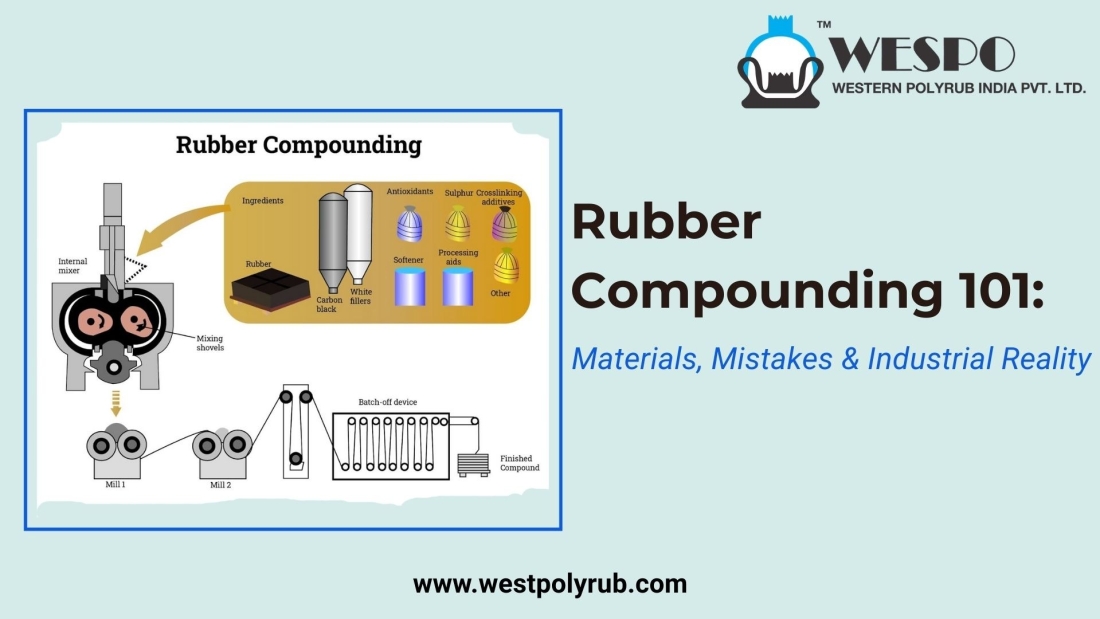
Rubber compounding is the process of blending raw elastomer with selected ingredients to achieve specific physical, chemical, and mechanical properties.
That sounds simple. It isn’t.
Raw rubber on its own is inconsistent, unstable, and unsuitable for most applications. Compounding transforms it into a usable material by carefully balancing flexibility, strength, aging resistance, temperature tolerance, and processability.
Related Topic : Rubber Extrusions in Automotive & EV Sealing: What OEMs Need to Know
Why Rubber Compounding Matters More Than Most Buyers Realize
Here’s the uncomfortable truth:
Two rubber parts can look identical, feel identical, and still behave very differently after six months in service.
Why?
Because the rubber compound formulation behind them is different.
Compounding determines:
-
How rubber reacts to heat over time
-
How it handles oil, steam, or chemicals
-
How it compresses, rebounds, and ages
-
How predictable its performance remains in real-world conditions
This is why experienced OEMs don’t just ask “What material is this?”
They ask “How is the compound built?”
Core Materials Used in Rubber Compounding
1. Base Elastomers (The Foundation)
Every rubber compound starts with a base polymer. Common choices include:
-
Natural Rubber (NR) – Excellent elasticity, limited heat resistance
-
EPDM Rubber – Strong weather, ozone, and steam resistance
-
Nitrile Rubber (NBR) – Designed for oil and fuel exposure
-
Silicone Rubber – Extreme temperature stability
-
FKM (Viton®) – High chemical and heat resistance
Choosing the wrong base elastomer is a mistake that no additive can fix later.
2. Fillers: Strength vs Cost vs Performance
Fillers are often misunderstood. They don’t just reduce cost.
-
Carbon Black improves tensile strength, abrasion resistance, and durability
-
Silica improves flexibility and low-temperature performance
But here’s the catch:
Overloading fillers may boost strength on paper while quietly killing fatigue life.
This trade-off shows up months later — not during testing.
3. Plasticizers & Processing Oils
Plasticizers adjust hardness and flexibility. They also affect aging.
This is where many low-cost compounds cut corners.
Short-term softness looks great. Long-term migration does not.
4. Curing Systems (The Point of No Return)
Curing locks the compound’s properties permanently.
-
Sulfur curing offers flexibility and cost efficiency
-
Peroxide curing provides better heat resistance and compression set
Once cured, there’s no undo button. Mistakes here are permanent.
The Rubber Compounding Process (What Happens on the Shop Floor)
Step 1: Ingredient Weighing & Sequencing
Accuracy matters more than speed. Even small deviations change behavior.
Step 2: Mixing (Internal Mixer or Mill)
This is where theory meets reality.
Heat buildup, shear force, and mixing time all affect final properties.
Two batches with the same formula can behave differently if mixing discipline slips.
Step 3: Cooling & Maturation
Rushed compounds cause processing problems later.
Good compounds are allowed to stabilize.
Step 4: Quality Checks Before Use
Mooney viscosity, dispersion quality, and batch consistency are checked before the compound ever reaches production.
Skipping this step is asking for returns.
Common Types of Rubber Compounds Used in Industry
-
Heat-resistant rubber compounds
-
Oil- and fuel-resistant compounds
-
Food-grade and medical-grade compounds
-
Low-compression-set sealing compounds
-
Weather and ozone-resistant compounds
Each exists for a reason. Universal rubber doesn’t exist.
Industrial Applications of Rubber Compounding
Automotive & EV Components
Seals, gaskets, hoses, vibration dampers.
Temperature cycles and fluid exposure demand stable compounds.
Sealing Systems & Rubber Extrusions
Performance depends on consistency.
Poor compounding shows up as leakage, not immediate failure.
Pharma, Food & Cleanroom Equipment
Compliance, purity, and repeatability matter more than raw strength.
Heavy Engineering & Machinery
Fatigue resistance and long-term stability decide lifecycle cost.
Common Rubber Compounding Mistakes
-
Designing only for initial test results
-
Ignoring aging and compression set behavior
-
Over-optimizing cost at the compound level
-
Treating all EPDM or NBR as equal
These mistakes don’t show up immediately. That’s why they’re expensive.
Frequently Asked Questions
Rubber compounding is the process of blending elastomers with additives to create a rubber compound tailored for specific performance requirements.
Base polymers, fillers, plasticizers, curing agents, antioxidants, and processing aids.
Aging, heat exposure, chemical attack, and poor compound balance are common causes.
Yes. EVs introduce new thermal, vibration, and chemical demands that require adjusted compound formulations.
No. Each application demands specific properties. One-size-fits-all compounds are a risk.
Rubber Compounding Trends OEMs Are Paying Attention To
-
Custom compound development instead of off-the-shelf grades
-
Low-extractable and low-odor compounds
-
Compounds optimized for EV thermal profiles
-
Material traceability and batch consistency
-
Longer service life over short-term cost savings
This shift isn’t theoretical. Procurement teams are already adjusting specs.
Final Thought
Most rubber failures don’t look dramatic.
They show up quietly — as downtime, leaks, or repeated replacements.
Understanding rubber compounding won’t just help you choose better materials.
It helps you avoid problems that are impossible to fix once production starts.
And that’s the part most people learn too late.


Add a Comment