
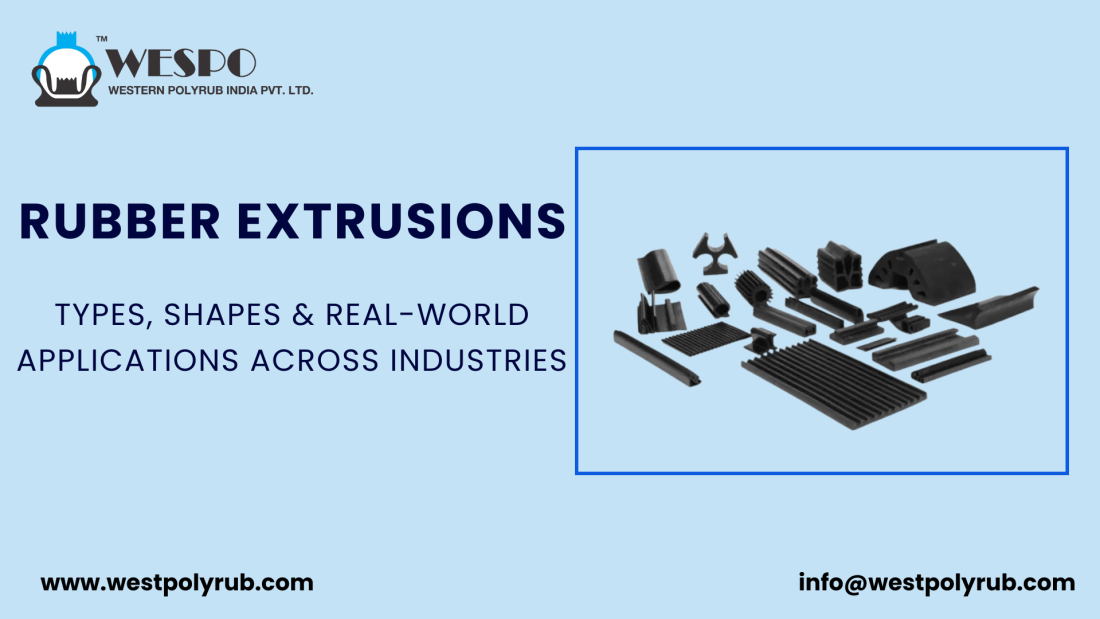
Rubber Extrusions: Types, Shapes & Applications Across Industries
A Practical Guide for OEMs, Engineers & Industrial Buyers
Rubber extrusions don’t sell themselves. They only get noticed when something goes wrong—water leaks in, noise creeps up, panels stop aligning, or equipment starts vibrating more than it should.
That’s why most serious OEMs, EPC contractors, and plant teams don’t look at extrusions as “rubber parts.” They look at them as risk-control components.
This guide is written for people who actually specify, source, or approve rubber extrusions—not for textbook readers.
We’ll cover rubber extrusion types, common rubber extrusion shapes, material choices, and where each one makes sense in real industrial conditions.
What Rubber Extrusions Really Are
Yes, rubber extrusions are continuous profiles made by forcing compounded rubber through a die. But in practice, they are:
The difference between a quiet cabin and a noisy one
The line between IP-rated sealing and warranty claims
The part that absorbs tolerance variation when metal and plastic don’t behave
Unlike molded rubber parts, extrusions are chosen early in design—and blamed late when problems surface.
That’s why understanding them properly matters.
Related Topic :
Inside Rubber Compounding: Materials, Additives & Real-World Performance Trade-Offs
How Rubber Extrusions Are Manufactured
Most buyers don’t need every process detail—but you do need to know where failures usually start.
1. Rubber Compounding (Where Performance Is Decided)
The compound defines:
Compression set
Weather resistance
Chemical compatibility
Aging behavior
Two extrusions with the same shape can perform very differently if the compound isn’t right.
2. Extrusion Through Precision Dies
The die controls:
Profile accuracy
Wall thickness consistency
Repeatability over long lengths
Cheap dies save money upfront and cost more later.
3. Vulcanization and Curing
Improper curing leads to:
Poor elasticity
Premature cracking
Loss of sealing force over time
This is where many low-cost suppliers quietly cut corners.
Why Rubber Extrusion Shapes Matter More Than Most People Think
Most failures aren’t caused by “bad rubber.” They’re caused by wrong geometry.
The right rubber extrusion shape:
Seals evenly with minimal force
Compensates for tolerance variation
Maintains performance after thousands of compression cycles
The wrong one looks fine during installation—and fails six months later.
Common Rubber Extrusion Shapes
Solid Rubber Extrusions
Simple rectangular or square profiles.
Used for:
Spacers
Impact buffers
Basic sealing where compression is controlled
Limit: Minimal flexibility.
D-Section Rubber Extrusions
One of the most widely used profiles.
Used for:
Automotive doors and panels
Industrial enclosures
HVAC systems
They compress predictably and recover well—if the compound is right.
U-Channel and Edge Trim Profiles
Designed to grip edges securely.
Used for:
Sheet metal protection
Glass and panel edges
Equipment housings
Installation is easy. Long-term grip depends on material hardness and design.
Bulb and Hollow Rubber Extrusions
Internal cavities reduce compression force.
Used for:
Weather sealing
Automotive body sealing
Doors with uneven gaps
They seal better at lower closing forces—critical in EV and lightweight designs.
Multi-Lip and Complex Profiles
Engineered for demanding environments.
Used for:
Noise and vibration control
Air and water management
Automotive and rail applications
These profiles perform extremely well—but only when tolerances are understood upfront.
Custom Rubber Extrusion Shapes
Standard profiles don’t always survive real-world conditions.
Custom extrusions are justified when:
Gaps vary across assemblies
One profile must seal, cushion, and guide
Space constraints exist
Regulatory or performance standards apply
If you’re modifying a standard profile repeatedly, you probably need a custom one.
Materials Used in Rubber Extrusions
Choosing material based only on price is how failures happen.
Common Materials
EPDM
Excellent for outdoor, UV, ozone, and weather exposure.
NBR (Nitrile Rubber)
Chosen for oil and fuel resistance.
Silicone Rubber
High-temperature stability, clean applications, food and medical use.
FKM (Viton®)
Handles aggressive chemicals and extreme heat.
TPE / TPV
Used where weight reduction and recyclability matter.
Material selection should be driven by environment, not habit.
Where Rubber Extrusions Are Used Across Industries
Automotive & Electric Vehicles
Door, window, hood, and trunk seals
Noise and vibration control
Thermal and dust sealing
EVs demand quieter cabins and lighter components—extrusions must work harder with less material.
Construction & Infrastructure
Window and façade sealing
Expansion joints
Weatherproofing systems
Movement, temperature cycles, and UV exposure define material choice here.
Industrial Equipment & Machinery
Enclosure sealing
Dust and fluid protection
Vibration damping
Downtime caused by seal failure costs far more than the extrusion itself.
Food, Pharma & Medical
FDA-compliant silicone extrusions
Autoclave door seals
Cleanroom applications
Consistency and traceability matter as much as performance.
Rail, Marine & Heavy Engineering
Hatch and compartment seals
Vibration isolation
Weather and water barriers
Long service life outweighs initial cost in these sectors.
When OEMs Should Move to Custom Rubber Extrusions
Custom profiles make sense when:
Standard shapes require frequent rework
Field failures keep repeating
Assembly variation can’t be controlled
Performance requirements are non-negotiable
Most OEMs delay this decision longer than they should.
Design Checks Before Finalizing an Extrusion
Before freezing a profile, ask:
What compression range will it see in real use?
How will it age after heat, UV, or chemicals?
Is installation manual or automated?
What happens when tolerances stack up?
Skipping these questions usually shows up as warranty claims later.
Market Trends Shaping Rubber Extrusions
Search behavior and OEM demand show growth in:
Lightweight sealing for EV platforms
Sustainable and recyclable elastomers
Multi-material and co-extruded profiles
Simulation-based profile design
Longer-life weather sealing systems
Suppliers who can’t support these are slowly getting filtered out.
Why Supplier Selection Matters More Than Profile Selection
Two suppliers can quote the same profile and material—and deliver very different outcomes.
What separates reliable extrusion suppliers:
Strong compounding control
Tooling accuracy
Consistent curing processes
Application-level support
Price matters. But failure costs more.
Frequently Asked Questions
They are used for sealing, edge protection, vibration control, insulation, and noise reduction
Solid strips, D-sections, U-channels, bulb seals, hollow profiles, and multi-lip designs.
Extrusions have a constant cross-section and are cut to length; molded parts have fixed geometries.
EPDM is commonly preferred due to weather and UV resistance.
Yes. Profiles can be engineered to meet specific dimensional, performance, and compliance requirements.
Ready to Specify or Source Rubber Extrusions?
If you’re:
Developing a new product
Facing repeat sealing issues
Looking to reduce warranty risks
Evaluating alternative materials or profiles
Talk to a manufacturer who understands application behavior, not just drawings.
👉 Discuss your application requirements or request a profile review on Rubber Extrusions.


Add a Comment